The SaaS Apocalypse That Isn't: How AI Will Reshape — Not Replace — Software as a Service

D. Rout
March 25, 2026 8 min read
On this page
Every few years, a technology wave rolls in and the hot take machine kicks into overdrive: "This is the end of X." Cloud killed on-premise software (sort of). Mobile killed the desktop (not really). And now, AI is supposedly coming for SaaS.
But before you start drafting the obituary for your favorite project management tool, let's slow down and look at what's actually happening — and what it means for builders, buyers, and investors in the software ecosystem.
The Hype Cycle Is Real — But So Is the Nuance
There is a grain of truth in the AI-kills-SaaS narrative. Tools like GitHub Copilot, Cursor, and a slew of AI coding assistants have dramatically lowered the barrier to writing and shipping software. A solo developer today can ship what once required a team of five. Startups are reaching their MVPs in weeks, not months.
This is genuinely disruptive — but disruption is not the same as obliteration.
AI, as it stands today, is fundamentally a force multiplier, not a replacement engine. It accelerates human decision-making, automates repetitive tasks, and compresses development timelines. It is a power tool, not a wrecking ball.
The question was never "Will AI replace SaaS?" — it's "What does SaaS look like when AI is the default?"
SaaS Is a Business Model, Not Just a Technology
This is where a lot of the discourse goes wrong. When people say "AI will kill SaaS," they're conflating two different things: the delivery mechanism (subscription-based cloud software) and the product category (vertical apps for HR, CRM, finance, etc.).
SaaS as a business model — recurring revenue, cloud delivery, multi-tenant architecture — is extraordinarily resilient. It solved a real problem: companies don't want to manage servers, pay for perpetual licenses, or wait 18 months for upgrades. Those problems haven't gone away.
What has changed is how software gets built, how differentiated it needs to be, and how much customers are willing to pay for commoditized features.
To understand how robust this model has proven to be, it's worth revisiting the fundamentals of what makes SaaS so sticky:
→ a16z: The SaaS Metrics That Matter
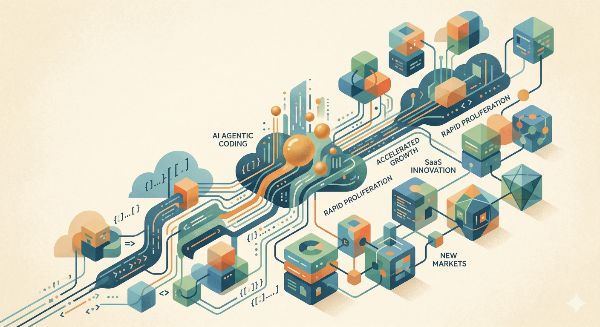
The Coming Proliferation of New SaaS
Here's the counterintuitive truth: AI will likely increase the number of SaaS products in the world, not decrease it.
Lower development costs mean the minimum viable business gets smaller. A niche that couldn't previously support a standalone software company — say, compliance tracking for dental practices in the EU, or shift scheduling for independent breweries — suddenly becomes economically viable to serve.
We are entering an era of hyper-vertical SaaS: extremely focused applications built cheaply, often by small teams or even solo founders, targeting audiences that legacy vendors have always been too big to care about.
This is already happening. The number of AI-native startups building vertical SaaS has exploded since 2023. Tools like Lovable, Bolt, and v0 let non-engineers ship functional web applications in hours.
→ Y Combinator: Building AI-Native Products
For buyers, this means more choice. For incumbents, this means more competition — even from sources that didn't exist two years ago.
The Existential Risk for Incumbent SaaS Players
Here is where the threat is real — and where legacy SaaS companies should be paying very close attention.
1. Feature Commoditization at Scale
Many SaaS products are built around a core insight that was defensible in 2015: "We built this workflow better than a spreadsheet." That moat is eroding fast. AI can now generate personalized workflows, automate data entry, surface insights, and connect disparate systems — all things that used to require dedicated software.
If your SaaS product's value proposition is "we do X better than a spreadsheet," you need a new pitch. AI is coming for that argument.
2. Margin Compression Is Coming
More competition means downward pressure on pricing. Customers who once had two or three options in a given category will soon have ten or fifteen — many of them AI-native and lean enough to undercut on price. This is healthy for the market, but painful for incumbents who built their unit economics around the assumption that switching costs would stay high forever.
3. The Switching Cost Problem
One of SaaS's great defenses has always been switching costs — data lock-in, workflow dependency, training overhead. AI agents that can migrate data, learn user patterns, and onboard teams faster are beginning to erode this moat. It's not gone, but it's getting thinner.
→ Harvard Business Review: How SaaS Companies Can Prepare for the AI Era
What Survival Looks Like: The Adapt-or-Fade Imperative
The SaaS companies that will thrive through this transition share a few characteristics. None of them involve standing still.
Embed AI at the Core, Not the Edge
There's a temptation to bolt an AI chatbot onto an existing product and call it "AI-powered." Customers are already seeing through this. The SaaS products that will win are those that rethink their core workflows around AI — not those that add a chatbot to their settings page.
Think of how Notion went from a document editor to an AI-native workspace, or how HubSpot has been rearchitecting its CRM around predictive intelligence. These aren't cosmetic changes — they're fundamental rethinks of how the product creates value.
Own the Data Layer
AI models are commodity infrastructure. The data that trains them and the workflows that generate it are not. SaaS companies that sit on rich, proprietary datasets — usage patterns, industry-specific benchmarks, historical records — have a real advantage that pure-AI alternatives can't easily replicate overnight.
If you're building SaaS today, think hard about what data your product uniquely accumulates and how you can leverage it as a strategic asset.
Double Down on Trust and Compliance
AI is powerful but imperfect. In regulated industries — healthcare, finance, legal, government — there is enormous value in software that is auditable, compliant, and predictable. This is a place where established SaaS vendors, with their compliance certifications and audit trails, have a genuine edge over AI-native newcomers moving fast.
→ Gartner: What Is Agentic AI and What Does It Mean for Enterprise Software?
A Note on Agentic AI: The Longer-Term Wild Card
There is one scenario that genuinely could reshape SaaS more dramatically: agentic AI.
If AI agents can autonomously execute multi-step tasks — browse the web, call APIs, write code, manage data — then the need for discrete SaaS applications (each with their own UI, login, and workflow) starts to look different. Why log into five tools when an agent can orchestrate them all on your behalf?
This is not science fiction. It is early-stage reality. OpenAI's Operator, Anthropic's computer use, and Google's Project Mariner are all pointing in this direction.
But we are years, not months, away from this being the default way people work. Enterprises move slowly. Compliance concerns are real. And AI agents still make mistakes that would be unacceptable in mission-critical business processes.
The SaaS ecosystem has time to adapt — but the window is not unlimited.
→ Sequoia Capital: The AI Agent Opportunity
For Buyers: What This Means for Your Software Stack
If you're a business evaluating SaaS tools today, a few principles are worth keeping in mind:
Ask vendors hard questions about their AI roadmap. A vendor who can't articulate how AI is changing their product in the next 12 months is a vendor worth watching carefully — and possibly replacing.
Favor interoperability. In a world where AI agents may increasingly stitch tools together, software that plays well with others (open APIs, standard data formats) will age better than walled gardens.
Don't abandon working software for AI hype. Stability, reliability, and compliance still matter enormously. A proven SaaS tool that's integrating AI thoughtfully is often a safer bet than a shiny new AI-native alternative with six months of production history.
The Bottom Line
SaaS is not dying. It is evolving — and the pace of that evolution is accelerating.
AI is making it cheaper to build software, which will flood the market with new options. That's good for buyers and challenging for legacy vendors who've been coasting on switching costs and lack of competition. The companies that survive and thrive will be the ones who treat AI as a core design principle, not a marketing checkbox.
For the foreseeable future, SaaS will remain the dominant model for delivering business software. But "foreseeable future" in tech is measured in years, not decades — and every year of standing still is a year your competitors are moving.
The SaaS apocalypse isn't coming. But the SaaS reckoning? That one's already underway.
Further Reading & Learning
- a16z — The SaaS Metrics That Matter
- Harvard Business Review — How SaaS Companies Can Prepare for the AI Era
- Gartner — What Is Agentic AI?
- Sequoia Capital — The AI Agent Opportunity
- Y Combinator — Building AI-Native Products
- Lenny's Newsletter — The Future of SaaS
Have a take on where SaaS is headed? Drop it in the comments — the best predictions age in public.
Read next
Comments (0)
Join the conversation
Sign in to leave a comment on this post.
No comments yet. to be the first!